Myths versus facts
What people assume, and what the record says
Some of the tidiest stories about May Day are almost right, and a little less particular than the official pages.
- Myth: The bank holiday is always on 1 May.
- Fact: GOV.UK lists an “Early May bank holiday,” often a Monday at the beginning of May, not always the 1st. In 2026 it is Monday 4 May; in 2020 it was Friday 8 May. [source]
- Myth: GOV.UK calls it May Day.
- Fact: The fetched official page does not use the words “May Day” or “Mayday.” [source]
- Myth: The 1971 Act created the English early May holiday.
- Fact: Schedule 1 lists the first Monday in May for Scotland, not for England and Wales. The National Trust dates the English holiday to 1978. [source] [source]
- Myth: Your employer must give you paid leave on the bank holiday.
- Fact: GOV.UK says: “Your employer does not have to give you paid leave on bank or public holidays.” [source]
- Myth: Helston Flora Day is the same as May Day, on 1 May.
- Fact: The official Flora Day site says the festival “is usually held on 8th May.” [source]
- Myth: Padstow’s Oss come out on the early May bank holiday Monday, whatever the date.
- Fact: The organisers say they come out “each and every 1st of May.” [source]
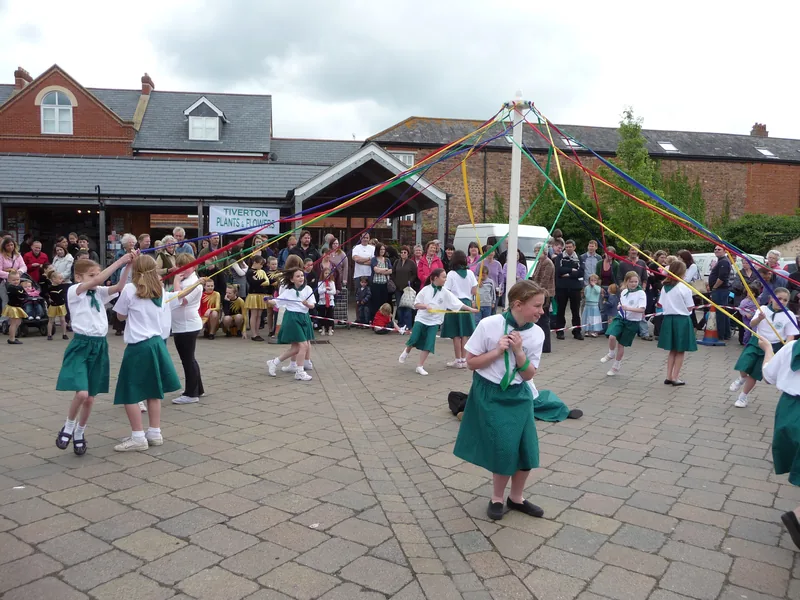
- Myth: Maypole dancing is an English invention of the Victorian period.
- Fact: The National Trust says the weaving of long ribbons “was first recorded in mid-14th-century Wales.” The Victorian and Edwardian May Queen, in white, is a later chapter. [source]
- Myth: May Day customs were never interrupted.
- Fact: The Trust says the most comprehensive campaign against them was in Cromwell’s Commonwealth, and that maypoles were raised again in 1660. [source]
- Myth: Every mid-May maypole photograph is a picture of 1 May.
- Fact: The Lostfest photograph on this site was taken on 19 May 2024. The caption says so. [source]
- Myth: The 2023 coronation holiday replaced early May.
- Fact: GOV.UK lists Monday 1 May 2023 as the Early May bank holiday, and Monday 8 May 2023 separately as the coronation bank holiday. [source]
- Myth: A photograph of hawthorn blossom, or of a mid-May festival, is automatically a picture of May Day itself.
- Fact: Hawthorn is often called May blossom, and the photograph on this site was taken on 17 May 2023. Lostfest was photographed on 19 May 2024. Both captions say so. [source]
- Myth: International Workers’ Day and the English early May holiday are the same official event.
- Fact: The National Trust records that the first of May was designated International Workers’ Day in 1891, and, separately, that the May Day bank holiday was instituted in 1978. They share a season. They are not the same decision. [source]
The aim is not to catch anyone out. It is to keep a good story standing on the wording that official and organisational pages actually use, so a curious reader can follow it back.
Keep exploring
Enjoyed May Day?
No pop-ups. No intrusive advertising. Just interesting stuff. A little support helps the next traditions site get built.