The bank holiday
GOV.UK calls it the Early May bank holiday
The official list of UK bank holidays does not use the words “May Day” or “Mayday.” It still gives you a Monday off in early May — except in 2020, when that holiday was a Friday.
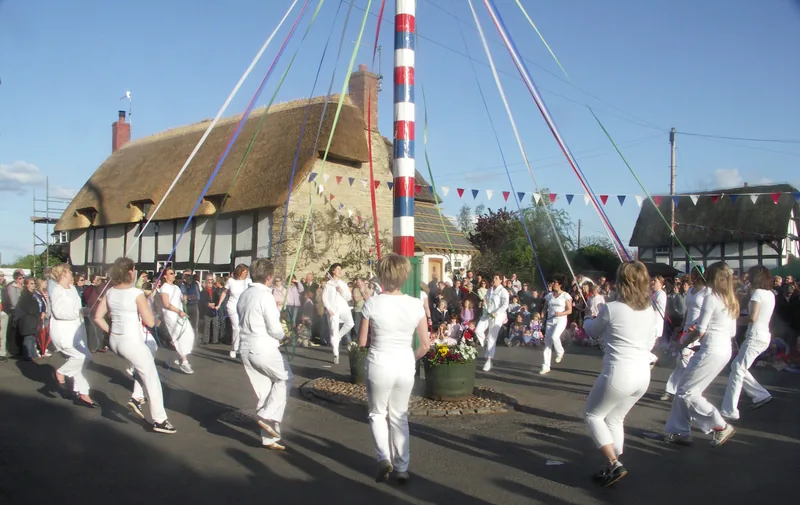
Open a drawer to look closer at maypoles, a hobby horse in Padstow, a Cornish dance on 8 May, and the bank holiday that arrived in 1978.
Ribbons, and a pole that stays up all year
The National Trust’s history of May Day calls the maypole “the quintessential image” of the day, and says the practice of weaving long ribbons into patterns “was first recorded in mid-14th-century Wales but eventually spread far and wide.” At Ickwell in Bedfordshire a maypole stands on the green even in February. A 2006 Geograph photograph describes it as “large, sturdy and apparently permanent.” [source]
Two horses are let loose on the first of May
The Padstow Obby Oss organisers describe “a May Day celebration quite unlike any other.” “Each and every 1st of May, the Old Oss and Blue Ribbon Oss are let loose from their stables to roam around Padstow.” A tradition, they say, “that has taken place for centuries,” filling the streets of the Cornish fishing port. [source]
A different date, and a bass drum at seven
Helston’s official Flora Day site says the festival “is usually held on 8th May,” not on the first. Houses and shops are decorated with greenery. “When the big bass drum strikes the first beat of the dance at seven in the morning,” couples dance through the streets, “entering selected houses and shops to drive out the darkness of winter and bring in the light of spring.” The Hal an Tow pageant sings of the Armada, St George, and St Michael and the devil. [source]
The early May holiday arrived in 1978
The National Trust says “the May Day Bank Holiday was instituted by Michael Foot, then the Labour Employment Secretary, in 1978.” GOV.UK, on its official list, does not use the words “May Day” or “Mayday.” It labels the holiday “Early May bank holiday.” In 2026 that falls on Monday 4 May; in 2027 on Monday 3 May; in 2028 on Monday 1 May. [source] [source]
Sweeps in gaudy clothes, and towers of silver
The National Trust writes that many exuberant May Day customs are “now mostly forgotten.” “Chimney sweeps wearing gaudy clothes would make mischief on the street and hustle for coins. Milkmaids would dance for pennies while balancing towers of borrowed silverware on their heads.” A 1778 satirical print, “Humours of May Day,” still shows sweeps dancing in Covent Garden. [source]
The poles came down, then went up again
“The most comprehensive campaign against May Day,” the National Trust says, “was waged during Oliver Cromwell’s Commonwealth. Upon the restoration of the monarchy in 1660, maypoles were raised across the land as a gleeful marker of the end of Puritan prohibitions.” [source]
Once, the early May holiday was a Friday
GOV.UK’s past list records Friday 8 May 2020 as the Early May bank holiday, marked “(VE day).” In 2023 the Early May bank holiday fell on Monday 1 May, and a separate “Bank holiday for the coronation of King Charles III” fell on Monday 8 May. Those are two different holidays, listed on the same official page. [source]
The National Trust, writing a history of the festival, says “the May Day Bank Holiday was instituted by Michael Foot, then the Labour Employment Secretary, in 1978.” GOV.UK’s current page labels the same early-May holiday, in the England and Wales, Scotland, and Northern Ireland tables, “Early May bank holiday.” Those two official names are both used on this site, each attributed to its page. [source] [source]

The dates on GOV.UK, as read on 17 November 2026, are Monday 4 May 2026, Monday 3 May 2027 and Monday 1 May 2028. Recent past dates include Monday 5 May 2025, Monday 6 May 2024 and Monday 1 May 2023. In 2023 a separate “Bank holiday for the coronation of King Charles III” fell on Monday 8 May. In 2020 the Early May bank holiday was Friday 8 May, marked “(VE day).” [source]
Those official dates are worth reading slowly. Most years the holiday is a Monday at the beginning of May, and only sometimes is that Monday the first of the month. In 2028 it will be. In 2026 and 2027 it is not. The 2020 Friday is the striking exception: a bank holiday moved to mark VE Day, still labelled “Early May bank holiday” on the official list. The 2023 coronation holiday did not replace early May; GOV.UK listed both. [source]
A royal proclamation, given at Buckingham Palace on 9 July 2025 and published in the London Gazette on 11 July, appointed Monday 4 May 2026 as a bank holiday in England, Wales and Northern Ireland, “in pursuance of sections 1(2) and 1(3) of the Banking and Financial Dealings Act 1971.” The same notice also appointed Thursday 1 January 2026 and Monday 28 December 2026, in place of Saturday 26 December, and Monday 13 July 2026 in Northern Ireland. The proclamation does not name that May Monday “May Day,” and it does not appoint a Scottish holiday. [source]
GOV.UK also says: “If a bank holiday is on a weekend, a ‘substitute’ weekday becomes a bank holiday, normally the following Monday.” And: “Your employer does not have to give you paid leave on bank or public holidays.” That second sentence is easy to miss, and it is as official as the date itself. The list tells you which day is a bank holiday. It does not, by itself, promise a paid day off. [source]
If you are looking for maypoles, Padstow or Helston, those belong to the first of May, or, in Helston, usually to the 8th. The official Monday is often nearby, and only sometimes is it the same sunrise. That is not a defect in the festival, or in the official list. It is how the season is actually arranged, and it is one reason the stories on this site are told separately, each with its own date, so a reader can enjoy the maypole, the Oss, the Flora Day dance and the official Monday without having to pretend they are a single event. [source] [source] [source]
Keep exploring
Enjoyed May Day?
No pop-ups. No intrusive advertising. Just interesting stuff. A little support helps the next traditions site get built.